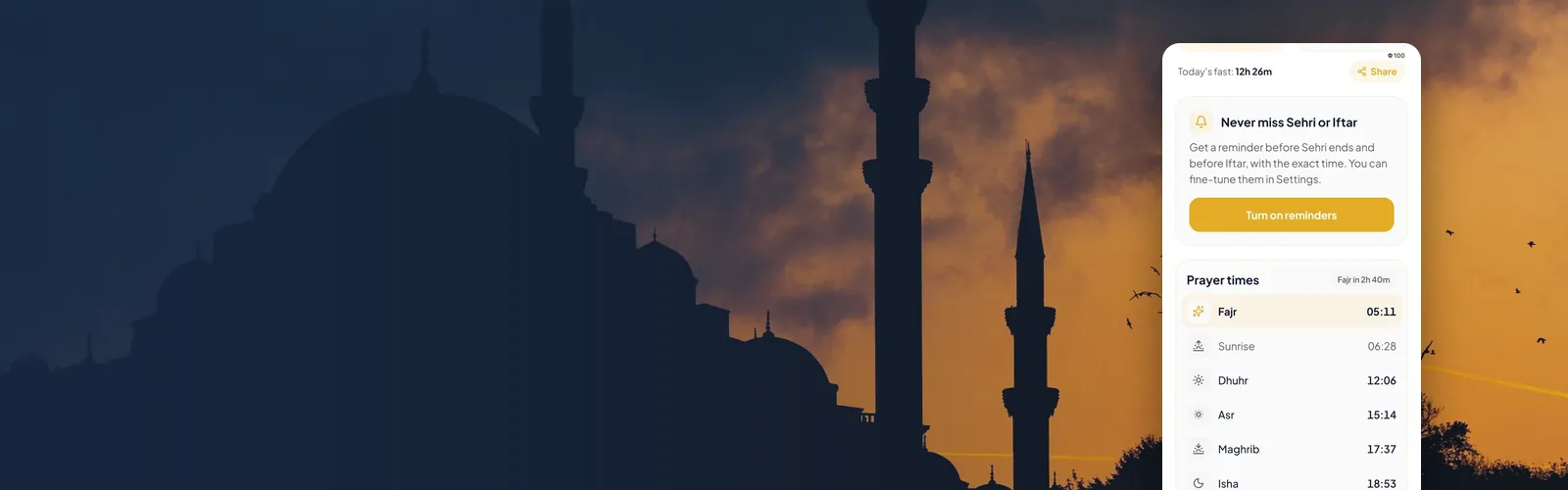
Short answer: the Today screen in Iftar Times lists Fajr, Sunrise, Dhuhr, Asr, Maghrib and Isha for your location, highlights the next prayer and shows how long until it begins. Times are calculated on your phone, so they work offline and when you travel.
What each time means
- Fajr begins at true dawn and lasts until sunrise. In Ramadan it's also when Sehri ends.
- Sunrise marks the end of Fajr time.
- Dhuhr begins just after the sun passes its highest point, solar noon.
- Asr begins when an object's shadow reaches a set length: standard or Hanafi.
- Maghrib begins at sunset, which is also Iftar.
- Isha begins when the last twilight has left the western sky.
What the app shows
- All six times for today, with the next prayer highlighted and the time left until it starts.
- Times in the local time of the place you choose, so a saved location abroad shows that city's own times.
- A 12-hour or 24-hour clock, and light or dark mode to match your phone.
Settings to match your mosque
Prayer times vary between timetables mainly because of the Fajr and Isha method and the Asr opinion. In Settings → Calculation you can pick from twelve methods, or leave it on Automatic to use the one most common in your country, and choose Hanafi or standard Asr. Our guide to calculation methods compares them on real data.
Offline and private
The app doesn't fetch your times from a server. City search is built in, and the calculations run on your phone, so once it's installed it works with no signal, which helps on a plane or abroad. If you use your phone's location, the app only asks for approximate location, and it's used on the phone to work out your times.
Travelling
Save several places and switch between them in a tap: home, a city you're visiting, or where your parents live. Each one keeps its own times and timezone, which is also handy for checking when family abroad will break their fast.